NP Revolution
A full-stack Nepali digital news platform combining a public news experience with reporter workflows, authentication, role-based content management, media uploads, weather information, and editorial dashboards.

Overview
Purpose: Build a modern Nepali news platform serving both readers and reporters from one application.
Target users: News readers; reporters; editorial/admin users.
- Categorized news homepage
- Breaking news
- Video news
- Trending content
- Weather
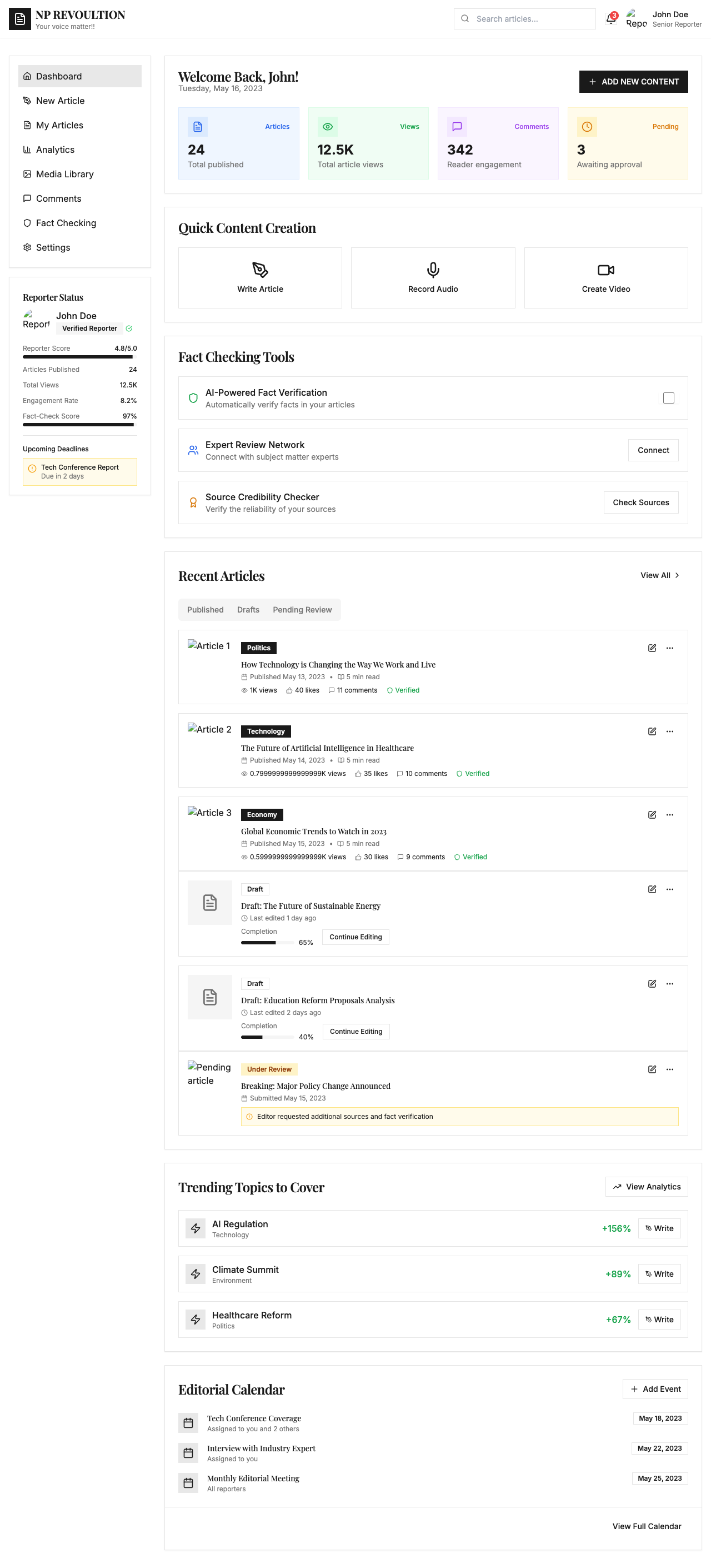
- Reporter dashboard
- Content creation
- Role-based content management
- Media uploads
- Authentication
- Google OAuth
- Light/dark themes
Tech Stack
No README or docs anywhere in the repo; all of the above is read directly from package.json files and how (or whether) each dependency is actually imported in code, not from documentation.
Frontend
- Vite
- React 19
- React Router
- Tailwind CSS
- Radix UI / shadcn-style components
- Lucide React
- React Icons
Backend
- Express 4
- Joi
- Multer
- Helmet
Database
- MongoDB
- Mongoose
Auth
- JWT
- bcryptjs
- Passport
- Google OAuth
- Cookie sessions
Features
News Homepage
Breaking-news ticker, hero stories, editor's picks, live updates, trusted sources, popular tags, trending topics, category-grouped news, video stories, newsletter signup, weather.
How: The UI is decomposed into reusable content and editorial components.
Reporter Dashboard
Article statistics, view and engagement information, draft/published/review states, content shortcuts, editorial calendar, trending story opportunities, fact-checking tools.
Content CRUD
Structured content management with public article reads, reporter-authorized writes, draft/published/archived states, view tracking, tags and categories, media attachments, ownership validation.
Media Uploads
Multer handles media upload workflows with validation for supported image/video formats and controlled file limits.
Authentication
Email/password registration and login, JWT authentication, reporter role validation, Google OAuth, token verification.
Weather Integration
The homepage integrates current weather data to enrich the local news experience.
Theme System
A persistent light/dark theme preference is stored in the browser and applied at the document level.
Architecture
Folder structure: Backend separates controllers, middleware, models, routes, upload utilities, and authentication configuration.
Database Design
- User — Username, email, password hash, role, timestamps
- Reporter — User reference, verification status, biography
- Content — Title, body, author, media, category, tags, publication status, views, created/updated timestamps
The model supports a clear reader/reporter/editor workflow.
API Documentation
| Method | URL | Purpose | Auth |
|---|---|---|---|
| POST | /api/auth/register | Register account | Public |
| POST | /api/auth/login | Login | Public |
| GET | /api/auth/verify-token | Verify token | Authenticated |
| GET | /api/auth/google | Google OAuth | Public |
| GET | /api/auth/google/callback | OAuth callback | Google auth |
| GET | /api/content | List content | Public |
| GET | /api/content/:id | Read article | Public |
| POST | /api/content | Create content | Reporter |
| PUT | /api/content/:id | Update content | Reporter/owner |
| DELETE | /api/content/:id | Delete content | Reporter/owner |
Authentication Flow
login: Email/password → bcrypt verification → JWT issuance → authenticated API request → user resolution → reporter-role validation where required.
notes: Google OAuth provides an additional third-party sign-in path through Passport.
Screenshots

Challenges
Problem: Aligning Frontend and Backend Contracts — a content-heavy application has many data consumers and can drift if UI and API shapes evolve separately.
Solution: I aligned authentication and content responses behind consistent client/API boundaries and connected editorial views to the backend content lifecycle.
Problem: Combining JWT and OAuth — supporting both first-party credentials and Google OAuth requires a consistent application identity after authentication.
Solution: I normalized both flows into the same user/role model so downstream authorization follows one policy.
Problem: Reporter Authorization — content creation must be protected by more than login status.
Solution: I composed JWT authentication with reporter-role middleware and ownership checks for protected mutations.
Performance
- Vite development/build pipeline
- Componentized homepage
- Tailwind-based styling
- Client-side routing
- Reusable content components
- Efficient API separation between public reads and protected writes
Security
- Helmet middleware
- bcrypt password hashing
- JWT authentication
- Role-based authorization
- Joi validation
- Upload restrictions
- Environment-based secrets
- CORS configuration
- Rate-limiting capability
- OAuth configuration separated from application logic
Deployment
hosting: Separate frontend and backend packages, allowing independent deployment and scaling while sharing one MongoDB-backed content model.
Future Improvements
- Editorial review workflows
- Richer analytics
- Search
- Personalized feeds
- Real-time breaking-news updates
- Additional fact-checking automation
- Media processing
Lessons Learned
- Content systems need stable API contracts because many screens depend on the same entities.
- Role-based authorization must be enforced in backend middleware, not only in dashboard routing.
- File upload, authentication, validation, and business logic are easier to reason about when composed as explicit middleware stages.
- Building both reader and reporter experiences in the same product forces clearer separation between public and privileged capabilities.
Project Metrics
Timeline
- March 2025 — Project initialized with frontend and backend structure
- April 2025 — Routing, dashboard, authentication, content workflow, and UI refinement
Ask about this project
Depends on the /api/chat orchestrator and MCP tool server — not built yet (see plan.md).
Recruiter Summary
Role: Solo Full-Stack Developer
- Built a componentized React news portal
- Built a reporter-focused CMS dashboard
- Implemented Express/MongoDB content APIs
- Added JWT authentication and role-based authorization
- Implemented media uploads and Joi validation
- Added Google OAuth
- Integrated weather and theme functionality
- Connected public content and reporter workflows through one backend model
- Demonstrates rapid full-stack delivery across a public content product and a privileged editorial application
- Shows experience with authentication, RBAC, media upload, API design, and component-heavy React UI